
PN25

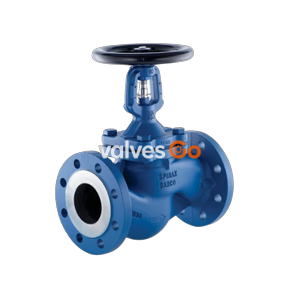
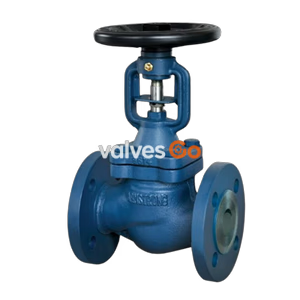
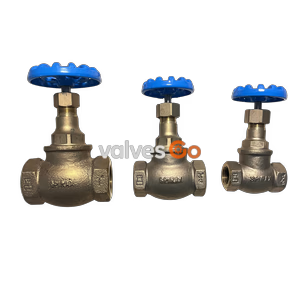
Yoshitake GLV-16 ductile cast iron globe valve. Suitable for steam, air, water, and oil. Features stainless steel disc, 2.2 MPa max pressure, and 220℃ max temperature.
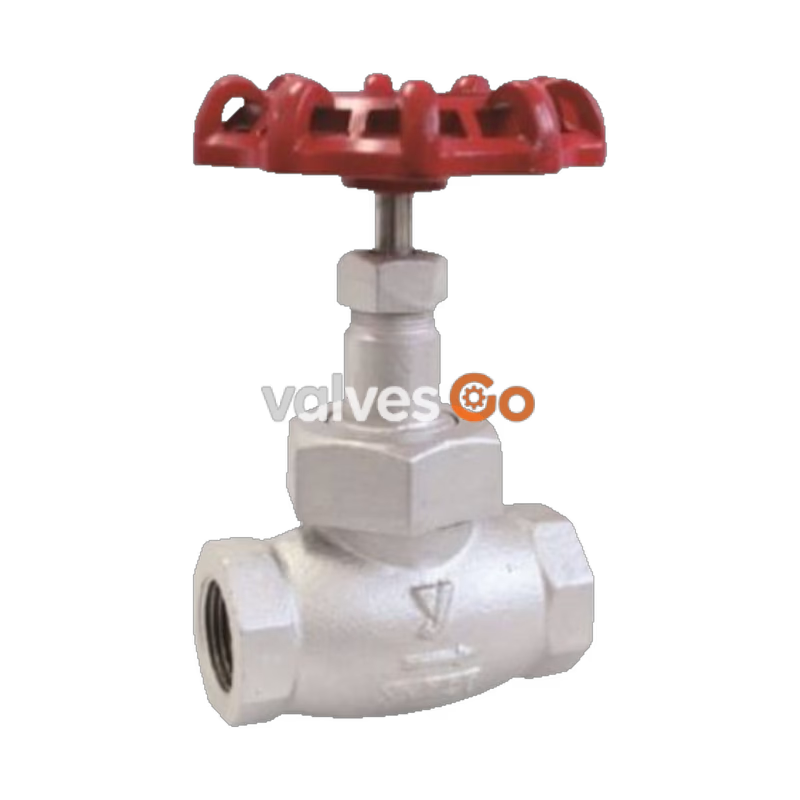
Yoshitake GLV-16 ductile cast iron globe valve is widely applicable for steam, air, cold and hot water, oil, and other non-dangerous fluids. The wetted parts are made of ductile cast iron, ensuring durability. The valve is closed at the time of shipment from the factory.
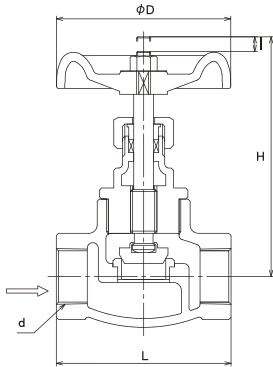
| Application | Steam, Air, Cold and hot water, Oil, Other non-dangerous fluids |
|---|---|
| Maximum pressure | 2.2 MPa *1 |
| Maximum temperature | 220℃ *1 |
| Body Material | Ductile cast iron |
| Bonnet Material | Ductile cast iron |
| Disc Material | Stainless steel |
| Connection | JIS Rc screwed |
Note
*1 The relation between pressure and temperature depends on P.2-3 JIS B 2051, pressure-temperature standard.
| Nominal size | d | L | H | D | Weight (kg) |
|---|---|---|---|---|---|
| 15A | Rc 1/2 | 75 | 126 | 83 | 0.9 |
| 20A | Rc 3/4 | 90 | 135 | 105 | 1.1 |
| 25A | Rc 1 | 105 | 150 | 112 | 1.7 |
| 32A | Rc 1-1/4 | 120 | 162 | 132 | 2.7 |
| 40A | Rc 1-1/2 | 135 | 183 | 132 | 3.8 |
| 50A | Rc 2 | 160 | 186 | 132 | 5.6 |
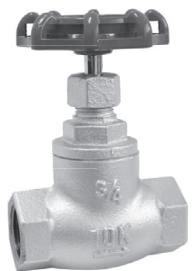
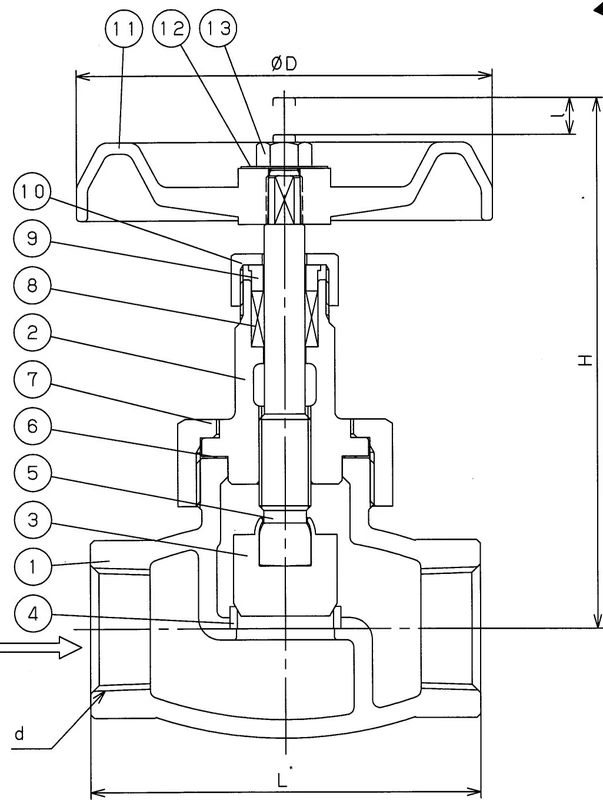
| No. | Part | Material | Qty |
|---|---|---|---|
| 13 | Nut | Steel | 1 |
| 12 | Name Plate | Aluminium | 1 |
| 11 | Handle | Aluminium | 1 |
| 10 | Gland Nut | Ductile Cast Iron (FCD450) | 1 |
| 9 | Gland Cover | Stainless Steel (SUS403) | 1 |
| 8 | Gland Packing | Expanded Graphite | 1 set |
| 7 | Bonnet Ring | Ductile Cast Iron (FCD450) | 1 |
| 6 | Gasket | Copper (C1100) | 1 |
| 5 | Spindle | Stainless Steel (SUS403) | 1 |
Caution
(1) Store the product indoors in a dust free, low humidity, dry and ventilated environment. (2) Installation should be conducted by suitably trained personnel, wearing protective head, eye, hand and foot protection. (3) To install the product, check the direction of the product so that the fluid flowing and the arrow marked on the product are in the same direction. (4) Be careful that the threaded connection between the mating pipe and the internal threaded connections of the valves are in line to avoid piping stresses in the valves. (5) During transportation or storage of the product leakage may occur from the gland nut due to decreasing of tightening pressure by stress relaxation of the packing. Be sure to retighten the gland nut before use. (6) When connecting the product and the piping, apply seal agent (such as seal tape) to the screw part of the piping. (7) In case that the product is expected to be frozen, be sure to conduct freezing prevention measures.
Warning
Before applying fluid, make sure that there is no danger if the fluid flows into the end of the piping. Failure to follow this notice may result in property damage due to fluid leakage.
Caution
(1) When using the product with its valve fully open, turn the handle counterclockwise by 45 degrees from the fully open position to prevent the valve from being stuck. (2) Be sure to open/close the valve by applying torque within the limit specified in "the valve User's Guide" published by the Japan Valve Manufactures Association. Do not apply torque more than specified. (3) Do not try to turn the handle beyond its fully open/closed positions. Otherwise the valve may be damaged.
| Trouble | Cause | Remedy |
|---|---|---|
| Outside leakage | 1. The gland nut is loosened. 2. The gland packing is damaged. 3. The spindle is damaged. | 1. Tighten the gland nut additionally. 2. Replace the product with new one. 3. Replace the product with new one. |
| Leakage from the valve and/or valve seat on complete closing | 1. The valve and/or valve seat is damaged. 2. Foreign substance is stuck. | 1. Replace the product with new one. 2. Remove the foreign substance. |
| Operation torque of the handle is abnormally large | 1. Too much tightening of the gland nut. 2. Foreign substance is stuck on spindle and screw part. | 1. Loosen the gland nut and tighten it again to the no leakage degree. 2. Remove the foreign substance. |
| Abnormal sound | 1. Each screw part is loosened. | 1. Retighten the loosened parts. |
Warning
Completely discharge the pressure inside of the product, line and equipment before inspection and maintenance. For high temperature fluid, cool down the product until it can be touched with bare hands. Failure to follow this notice may result in injury or burns due to residual pressure.
Please conduct periodic inspection about once a year in order to maintain optimal performance and function of the product.
Inspection items:
Yoshitake Isolation Valves / Globe Valves
GLV, BSV, FV, and HV series globe valves for threaded and flanged isolation duties.
Explore similar products in our catalog